Why Lake Tahoe Lakefront Property Is Hard to Value
Valuing lakefront property on Lake Tahoe can seem opaque. Many long-time owners bought 10, 20, or even 50 years ago simply to be on the lake. Now they struggle to understand what their property is worth in today's market. Prices have moved dramatically, inventory is extremely limited, and the variables that drive value aren't always obvious from the listing photos or the size of the house.
This guide outlines the primary factors I evaluate when pricing or analyzing lakefront property on both the California and Nevada sides of the lake, including Nevada's East Shore and California's West Shore of Lake Tahoe. Lakefront land in the Tahoe Basin is scarce on both sides. The goal here is to give buyers and sellers a clear framework for understanding value. That way, decisions are grounded in the attributes that matter rather than broad price-per-square-foot comparisons.
The factors below are the ones I focus on most when helping homeowners understand the value of their legacy property, or when advising buyers on what they're truly acquiring.
1. Verifiable TRPA Coverage on Lake Tahoe Lakefront Parcels
Verifiable TRPA coverage is one of the most important determinants of value. Coverage (the amount of allowable impervious surface) dictates what can realistically be built, rebuilt, or expanded on a parcel. Many older lakefront properties consist of modest cabins on relatively large lots. The true value often lies less in the existing structure and more in the redevelopment potential.
This is especially relevant for heirs who inherit a long-held family cabin. Without a current understanding of coverage, it's difficult to know whether the property is maxed out, has remaining capacity, or offers meaningful upside. The first practical step is to obtain a current survey. From there, a land planner can help interpret the coverage numbers and outline what's realistically buildable under TRPA rules.
For sellers, I recommend commissioning a survey early in the process, regardless of the age of the property. Once coverage is verified, it becomes possible to clearly communicate the redevelopment potential to buyers and to price the property accordingly. Properties with strong remaining coverage or clear paths to a meaningful rebuild or expansion command a premium.
How TRPA Land Coverage Works at Lake Tahoe
The Tahoe Regional Planning Agency (TRPA) defines land coverage as impervious surface. That includes homes, driveways, parking areas, and soil that's been compacted by human use. How much coverage a parcel is allowed depends on its land capability.
- Bailey land capability: TRPA uses the Bailey system for homes built before July 1, 1987, and for all commercial and multi-family property. It sorts land into classes 1 to 7. Base allowable coverage is 1% in classes 1 and 2, 5% in class 3, 20% in class 4, 25% in class 5, and 30% in classes 6 and 7.
- IPES: Vacant residential parcels are scored under the Individual Parcel Evaluation System instead. IPES gives each vacant parcel a numerical score and ranks it within its local jurisdiction.
- Legally existing coverage: Coverage created before February 10, 1972, or added later under a valid permit, is legally existing. Anything above the base allowance is called excess coverage, and a TRPA Site Assessment determines whether that extra coverage is grandfathered.
- The one-third-acre rule: Base percentages apply to a parcel's one-third-acre "most likely building site." The rest of a larger lot gets 1% unless a Determination of Allowable Coverage is done.
To verify coverage on a Lake Tahoe home, TRPA uses a Site Assessment for residential property and a Land Capability Verification for commercial or multi-family property. TRPA notes that a Land Capability Verification is often the best way to confirm allowable coverage on homes built before 1987. Either application needs a site plan prepared by a licensed professional, such as a surveyor, engineer, or architect. Lakefront site plans must show the high and low water lines. Once an application is complete, TRPA holds itself to a standard of issuing a permit in 120 days or less.
Coverage can also move between parcels. TRPA allows transfers when the sending parcel is equally or more sensitive than the receiving parcel, generally within the same Hydrologically Related Area. Projects with excess coverage commonly pay an excess coverage mitigation fee to the region's land banks, the California Tahoe Conservancy and the Nevada Division of State Lands. All of this is why verified coverage numbers carry so much weight with a Lake Tahoe lakefront buyer who's planning a rebuild.
Land capability classes, IPES scores, setbacks and height limits all shape what a lot can hold, and each works a little differently under the Lake Tahoe TRPA land coverage and setback rules.
2. Lake Tahoe Lakefront Frontage and Views
The amount of shoreline frontage and the quality of the views are fundamental. More frontage is generally better. A property that looks primarily at a neighbor's house or has limited usable shoreline trades differently than one with open water views and substantial linear frontage.
Accurate frontage measurements come from a survey. View quality is more qualitative but equally important. Direction, openness, and how private the shoreline is all influence buyer demand and ultimate value.
3. Pier Rights on Lake Tahoe
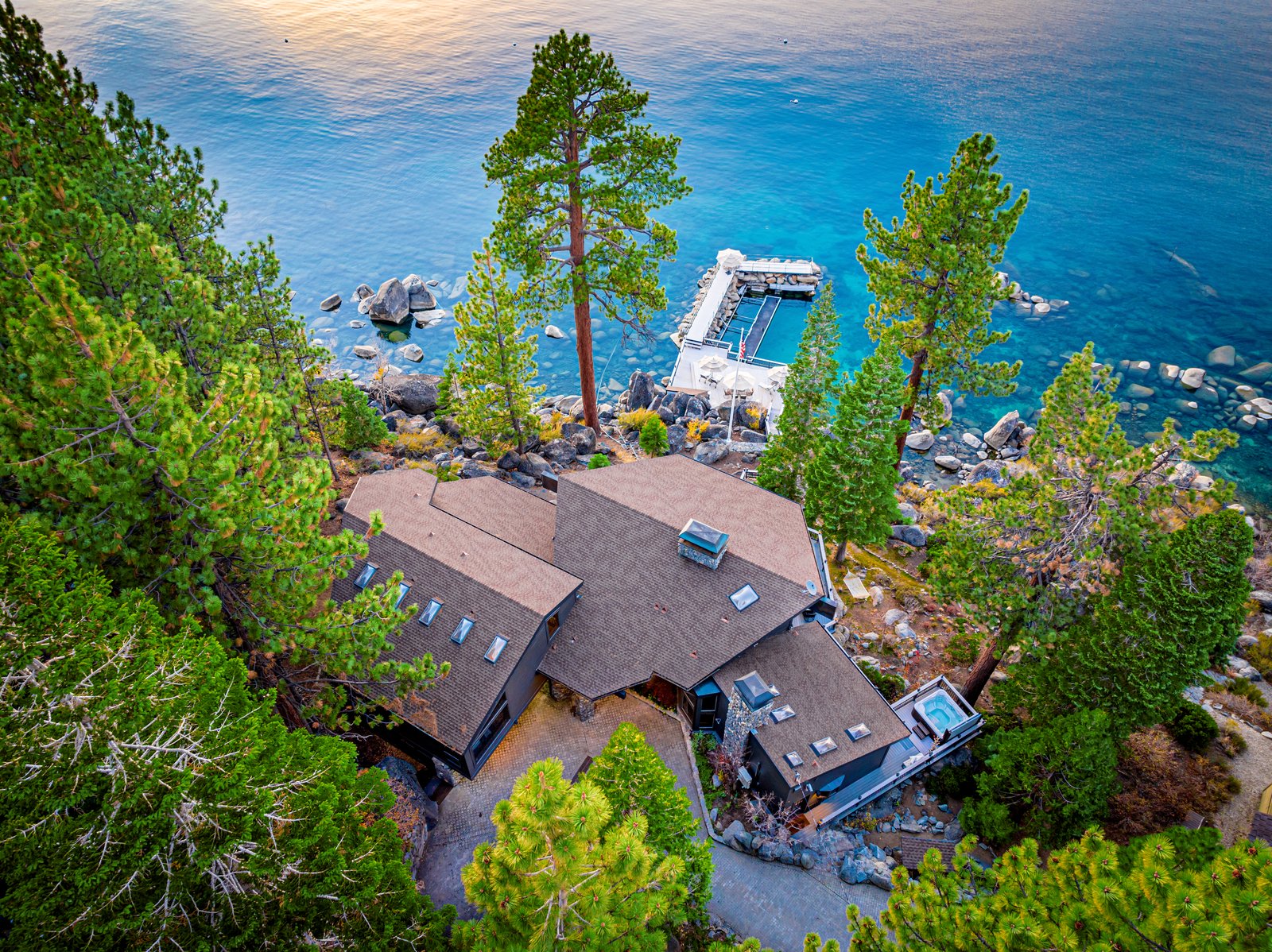
Pier rights are a major value driver. Relevant considerations include whether the property already has a permitted pier, the ability to reconstruct or improve an existing pier, and the potential to add a boat lift. You'll also want confirmation that the structure is recognized as a true pier by the appropriate state lands agency (the Nevada Division of State Lands or the California State Lands Commission).
The theoretical ability to pursue a new pier through the TRPA pier lottery exists, but the odds are low. TRPA's Shoreline Plan allows up to 12 new private piers every two years, and in the 2025 round, only two single-parcel piers were drawn from 56 proposals. Properties that already have clean, permitted pier rights (especially with boat-lift capability) are in a different category. Owners of older piers should also look at the TRPA rock crib pier addendum for Lake Tahoe lakefront owners, which changed the standards for non-conforming rock crib piers.
The crème de la crème of Tahoe lakefront is a parcel with a sandy beach and a pier with a boat lift. These attributes help explain the pricing levels seen along Lakeshore Boulevard in Incline Village on the North Shore: relatively flat lots, sandy beach, strong solar orientation (sun almost all day), and private pier access. Buyers consistently pay a significant premium for this combination.
Who Permits Piers, Buoys, and Boat Lifts on Lake Tahoe
A pier on Lake Tahoe involves more than one agency. TRPA regulates shorezone structures, and the state that owns the lakebed issues its own authorization.
- Nevada: The State of Nevada owns the land below elevation 6,223 feet. The Nevada Division of State Lands issues permits for piers, buoys, breakwaters, and boat hoists on state-owned submerged land. Its application packet treats any change of ownership as a new application, and the standard permit term is ten years.
- California: The California State Lands Commission's leasing authority extends lakeward from the low water mark at 6,223 feet. The state also holds a public trust easement between 6,223 and 6,228.75 feet. A 2016 Commission staff report counted 777 leases for piers, buoys, and other water-related structures at Lake Tahoe.
- Boat lifts: TRPA counts buoys, boat lifts, and boat slips as moorings. Existing moorings must be registered and permitted with TRPA, and registrations are renewed every year. New moorings are allocated through an annual lottery.
For a Nevada seller, the ownership-change rule affects timing. The buyer will need their own state lands authorization, so it pays to have the pier's permit history organized before you list.
4. Lot Size and Topography on Lake Tahoe Lakefront
Lot size matters, but it must be considered alongside topography and usability. A smaller, flat, easily accessible parcel can sometimes trade in a similar range to a larger but steep, rocky parcel with difficult water access. In recent years, and looking ahead, larger parcels are likely to command an increasing premium simply because of scarcity.
Flat lots with straightforward access to the water (as seen on much of Lakeshore) are valued differently than steep, rocky lots that require significant engineering or limit practical use of the shoreline. Both size and the character of the land feed into the valuation.
5. Condition of the House and Ease of Updating or Rebuilding at Lake Tahoe
The existing structure's condition and the relative ease of updating or replacing it affect both pricing and buyer appetite. A well-built but dated home that can be remodeled with a more straightforward permitting path is often more attractive than a property that effectively requires a full teardown and new construction.
Full rebuilds involve more time, cost, and regulatory complexity. When evaluating value, I consider how much of the existing structure can be retained or efficiently improved versus how much of the project will be new construction. This distinction influences both the price a buyer is willing to pay and the timeline and risk they're accepting.
Scenic rules are part of that complexity on the lake. TRPA applies scenic standards to projects located within or visible from a scenic resource area, and the Lake Tahoe shoreline is one of those areas. The required level of scenic review and mitigation can vary depending on whether the shoreline unit is in attainment.
If targeted updates would help your home show better before listing, Compass Concierge for Lake Tahoe sellers can front the cost of home improvement services with no interest. You repay when the home sells, the listing agreement ends, or 12 months pass, whichever comes first.
Applying These Factors as a Lake Tahoe Buyer or Seller
For sellers: The combination of verified coverage, accurate frontage, clear pier status, lot characteristics, and a realistic assessment of the existing structure's redevelopment potential forms the foundation of a defensible price. Getting a current survey early is one of the highest-leverage steps you can take.
For buyers: These same factors help separate properties that look similar on paper but differ a great deal in long-term value and usability. A smaller house on a parcel with strong coverage, substantial frontage, and existing pier rights can be worth more than a larger, newer home on a constrained or pier-less lot. Keep that in mind when you compare current Lake Tahoe lakefront properties.
Lakefront property on Lake Tahoe doesn't price cleanly on a simple price-per-square-foot basis. The variables above (coverage, frontage and views, pier rights, lot size and topography, and the practical path to updating or rebuilding) are the ones that most consistently explain differences in value.
Supply, Demand, and the Rarity of Your Lake Tahoe Parcel
One additional factor needs to be considered, especially in the current environment: pure supply and demand, and the specific rarity of the parcel. As of October 2026, there's a significant amount of capital looking for true legacy lakefront real estate on Lake Tahoe. When a parcel is extremely unique in size, location, frontage, access, or overall character, and nothing truly comparable has traded in the last three or four years, traditional comps become less definitive.
In those situations, you're more directly dealing with supply and demand. Understanding what's currently available, what's likely coming to market, and how limited the alternatives are can meaningfully influence pricing strategy. The technical factors above remain essential. Still, an experienced agent who understands the current scarcity can price a property more aggressively than might have been advisable in prior cycles. In the right circumstances, that approach can produce a substantial premium, potentially in the millions, simply because of how few comparable opportunities exist.
This dynamic doesn't mean ignoring the fundamentals. It does mean recognizing that the total rarity of a specific parcel (driven by size, location, shoreline attributes, and the house itself) carries real weight in today's market. It can support stronger pricing when the alternatives are limited.
Start Early: Clarity Drives Top-Dollar Pricing on Lake Tahoe
If you're a homeowner considering selling, even if the timeline is a year or two out, two steps are especially valuable. First, connect with a real estate agent you know and trust. Second, if you're not fully clear on the rights associated with your property (what can be done with the pier, remaining coverage, redevelopment potential, boat-lift possibilities, and so on), begin that process early.
Obtaining clear answers can take significant time. In some cases it can take 18 months to two years to work through permitting questions or to secure specific approvals such as a boat lift. The practical path is straightforward. Work with your agent to connect with the right land planner (and a contractor if design work is needed). Sit down and articulate your vision for the property, meaning what you'd ideally like to do with it. Executing that vision is secondary. The next buyer will want to understand the realistic possibilities.
Clarity is one of the strongest drivers of top-dollar pricing. When a seller can present a buyer with a clear, documented picture of what can be done on the parcel, uncertainty drops and willingness to pay increases. Buyers dislike unknowns. The question of "what can be built or improved here?" is one of the most common reasons a property fails to achieve its highest potential price. Removing that uncertainty early allows you to market the property with confidence and support a stronger price. That means completing the relevant surveys, land-planning work, and, where appropriate, key permitting steps.
The cost of starting early is primarily the land planner's fees (and any associated design or application costs). The benefit is the ability to walk a buyer through exactly what's possible and why the property should trade at a specific level. In an ideal scenario, the key questions are already answered and the path forward is documented before the home hits the market. That clarity is often what separates a strong sale from one that lingers or trades below its potential.
Lake Tahoe Lakefront Property Value FAQs
How is lakefront property on Lake Tahoe valued?
Lake Tahoe lakefront doesn't price cleanly on price per square foot. I look at verified TRPA coverage, shoreline frontage and views, pier rights, lot size and topography, and how easy the house is to update or rebuild. When nothing comparable has traded in three or four years, the rarity of the parcel carries extra weight too.
Does a pier add value to a Lake Tahoe lakefront home?
Yes. Pier rights are one of the biggest value drivers on Lake Tahoe, and clean, permitted pier rights put a property in a different category. A sandy beach plus a pier with a boat lift is the top tier, which is part of why Lakeshore Boulevard in Incline Village commands the prices it does.
How do I find out how much TRPA coverage my Lake Tahoe property has?
Start with a current survey, then have a land planner interpret the numbers. TRPA verifies coverage on Lake Tahoe homes through a Site Assessment, or a Land Capability Verification, which TRPA says is often the best route for homes built before 1987. Both need a site plan from a licensed professional.
What's the difference between Bailey and IPES on Lake Tahoe?
Both are TRPA systems for rating how much a Lake Tahoe parcel can be developed. Bailey sorts land into capability classes 1 to 7 and applies to homes built before July 1, 1987, plus commercial and multi-family property. IPES scores vacant residential parcels and ranks them within each local jurisdiction.
Can I get a new pier on Lake Tahoe?
It's possible, but the odds are low. TRPA's Shoreline Plan allows up to 12 new private piers every two years on Lake Tahoe, and only two single-parcel piers were drawn from 56 proposals in 2025. Parcels must be littoral with no existing pier, and TRPA notes that winning an allocation doesn't guarantee project approval.
Does a pier permit carry over when a Nevada lakefront home on Lake Tahoe sells?
On the Nevada side of Lake Tahoe, the Division of State Lands treats any change of ownership as a new application. That applies to piers in places like Glenbrook and Zephyr Cove. Sellers should have the pier's permit history organized before listing so the buyer can file promptly.
How long does it take to get a boat lift approved on Lake Tahoe?
In my experience, it can take 18 months to two years to secure specific approvals such as a boat lift on Lake Tahoe. TRPA counts boat lifts as moorings, and existing moorings must be registered and permitted. That's why I tell sellers to start early.
Should I get a survey before selling my Lake Tahoe lakefront home?
Yes. A current survey is one of the highest-leverage steps a Lake Tahoe lakefront seller can take, regardless of the age of the home. It confirms frontage and gives a land planner what they need to verify coverage, so you can show buyers the redevelopment potential and price accordingly.
Why don't comps always work for pricing Lake Tahoe lakefront property?
As of October 2026, a lot of capital is looking for true legacy lakefront on Lake Tahoe. When a parcel is extremely unique and nothing comparable has traded in the last three or four years, traditional comps become less definitive. In those cases, supply and demand drive more of the pricing strategy.
Get a Lake Tahoe Lakefront Home Valuation
If you own lakefront in Incline Village, Glenbrook, Zephyr Cove, or anywhere else on the lake and want to know what it's worth, request a Lake Tahoe lakefront home valuation or call me directly at (775) 901-1465. We'll go through coverage, frontage, pier status, and the rest together.
I'm part of Team Blair Tahoe at Compass, Lake Tahoe's #1 real estate team, with more than $2 billion in sales and 5,750+ properties sold.
This guide reflects local market experience and common valuation considerations as of October 2026. Individual properties vary. Coverage, pier status, and buildability should be verified with current surveys, TRPA, state lands agencies, and qualified professionals. This is not an appraisal.
