Why the Lake Tahoe Pier Lottery Matters to Lakefront Buyers
For buyers fortunate enough to be shopping for lakefront property on Lake Tahoe, one of the biggest variables is whether the parcel already has a private pier. Serious lakefront buyers strongly prefer a pier. It's not simply a convenience. It's often central to the lifestyle and the value of the property.
This guide explains the reality of the TRPA pier lottery at Lake Tahoe. I'll cover how scarce new pier allocations are, the odds of winning, and the long, multi-agency process you face after winning before a pier can be built and placed in the water.
Winning the lottery is only the first step, and often the easier one. Getting the pier designed, approved, past neighbor challenges, through Nevada State Lands (or California State Lands) and the Army Corps of Engineers, and then built is where most of the time, cost and risk sits.
The Scarcity of New Piers at Lake Tahoe: TRPA Shoreline Plan Data
Under the 2018 Shoreline Plan, TRPA can permit a maximum of 128 new private piers lake-wide, plus up to 10 new public piers. No more than about 20 percent of the private total may be single-parcel (private) piers. The strong preference is for multiple-parcel (shared) piers. Allocations come out in limited numbers every two years, up to 12 new private piers per cycle, and any unused allocations roll forward.
As of the 2025 allocation cycle, TRPA's Shorezone Allocations Report shows these cumulative results since the Shoreline Plan took effect:
- Multiple-parcel (shared) piers allocated: 35
- Single-parcel (private) piers allocated: 12
- Total private piers allocated: 47 out of the 128 maximum
Here's the breakdown by allocation period, per the Shorezone Allocations Report:
- 2019: 7 multi-parcel + 4 single-parcel
- 2021: 9 multi-parcel + 3 single-parcel
- 2023: 9 multi-parcel + 3 single-parcel
- 2025: 10 multi-parcel + 2 single-parcel
That's the entire universe of new private piers authorized under the current rules. Before the 2018 Shoreline Plan, a long-standing moratorium largely blocked new pier construction. The result is extreme scarcity. Once the remaining allocations are used up, no more new private piers will be available under the current plan.
Where the Remaining Lake Tahoe Pier Allocations Are
The same report breaks the 128-pier cap down by county. It currently shows 81 private pier allocations still remaining lake-wide:
Area | Maximum new private piers | Allocated so far | Remaining |
|---|---|---|---|
Douglas County and Carson City, Nevada | 21 | 10 | 11 |
Washoe County, Nevada | 21 | 8 | 13 |
Placer County, California | 58 | 26 | 32 |
El Dorado County and City of South Lake Tahoe, California | 28 | 3 | 25 |
For East Shore owners in Glenbrook, Cave Rock and Zephyr Cove, that means only 11 more new private piers are left for all of Douglas County and Carson City under the current plan. Visually Sensitive Areas are even tighter. Only multiple-parcel piers are allowed there, and the Shoreline Plan caps them at 3 piers each in the Douglas/Carson and Washoe quadrants.
How Hard Is It to Win the Lake Tahoe Pier Lottery?
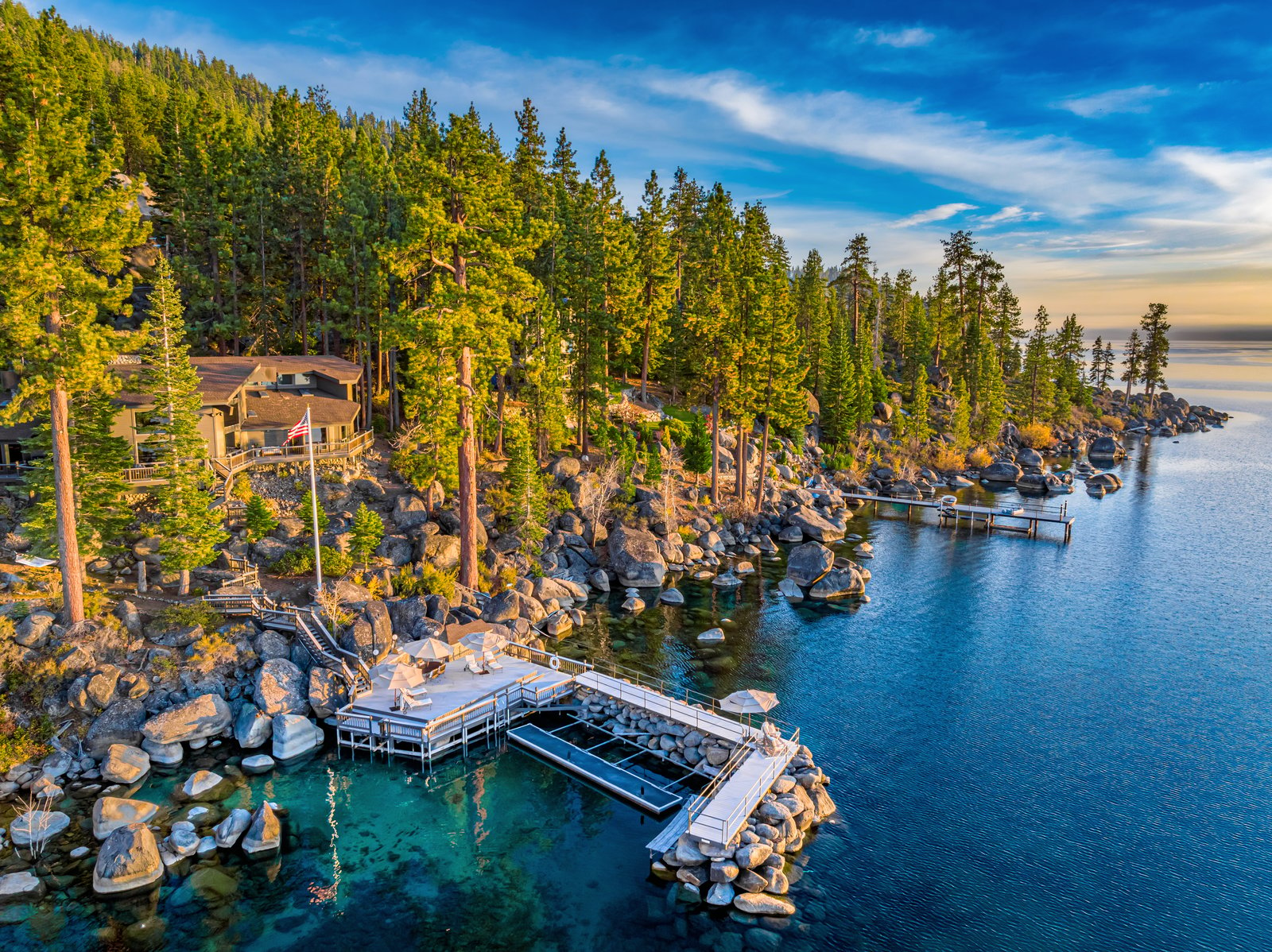
The process is heavily weighted toward shared (multiple-parcel) piers. TRPA scores and prioritizes multiple-parcel proposals using specific criteria in the TRPA Code before any lottery happens for ties. Single-parcel piers are picked purely by random drawing among eligible proposals.
In the 2025 cycle, for example, TRPA received 56 single-parcel proposals, and 52 were deemed eligible. Only two single-parcel allocations were available (one was returned from a prior cycle). That works out to roughly a 4% chance of being selected in that drawing.
Multiple-parcel proposals face stiff competition too. In 2025, TRPA reviewed 22 proposals for 11 multiple-parcel allocations. One was selected outright, and 17 proposals tied for the remaining spots, which were decided by random drawing after prioritization scoring.
You may notice the 2025 multi-parcel number is 11 here and 10 in the table above. Both come from TRPA. The pier allocation results page shows what was drawn on lottery day, and it lists 11 multiple-parcel allocations for July 2025. The Shorezone Allocations Report is TRPA's running tally, and it currently counts 10 for 2025. The two sources don't match exactly in other cycles either, but the overall picture is the same: roughly a dozen new private piers per cycle, and well under half of the 128 cap used so far.
Single-Parcel Pier Lottery Odds at Lake Tahoe, Cycle by Cycle
Here's how the single-parcel drawings have played out, based on TRPA's posted results:
Cycle | Eligible proposals | Allocations drawn | Approximate odds |
|---|---|---|---|
2019 | 65 | 5 | About 8% |
2021 | 93 | 4 | About 4% |
2023 | 54 | 3 | About 6% |
2025 | 52 | 2 | About 4% |
Odds vary each cycle depending on the number of eligible applications and the number of allocations available that year, but they stay consistently low for single-parcel (private) piers. Geographic distribution limits and scenic/visual sensitivity rules further limit opportunities in certain parts of the lake.
How Lake Tahoe Multiple-Parcel Piers Are Ranked
TRPA ranks shared pier proposals in this order of priority:
- The number of littoral parcels that retire their pier development potential within the same Scenic Character Type and Scenic Unit as the pier site.
- The total number of littoral parcels that retire pier development potential.
- Piers in less sensitive scenic areas (Visually Dominated ranks ahead of Visually Modified, which ranks ahead of Visually Sensitive).
- Proposals on a parcel that already has access to an HOA (or similar) multiple-use pier get the lowest priority.
In plain terms, the more neighbors who agree to give up their own future pier rights, the stronger a shared proposal scores. You can apply for both a single-parcel and a multiple-parcel pier if you're eligible for both. TRPA runs the multiple-parcel ranking first, and a property selected there is removed from the single-parcel lottery.
Who Can Enter the Lake Tahoe Pier Lottery
According to TRPA's New Pier Information Packet, eligibility turns on a handful of questions:
- The parcel must be littoral, meaning it adjoins the high-water elevation of Lake Tahoe.
- Whether a pier already exists on the parcel.
- Whether a deed restriction or covenant limits pier development.
- Whether the parcel sits in a Shorezone Preservation Area or a Stream Mouth Protection Zone, where new piers are prohibited.
- Whether the parcel is in a Visually Sensitive Area (single-parcel piers aren't allowed there).
- Whether the parcel already has access to an HOA, recreational association or other shared pier.
Proposals are accepted online for 30 days, June 1 to June 30, in odd-numbered years. The drawing happens in July. With the 2025 round complete, TRPA says the next allocation period opens in 2027.
You Won the Lake Tahoe Pier Lottery: What's Next?
Winning an allocation gives you the right to submit a full New Pier Application. It doesn't guarantee approval or construction. TRPA's own packet says receiving a pier allocation "does not guarantee that the proposed project can be approved." Winners get six months from the drawing to submit a complete shorezone application. For the 2025 round, that deadline was January 18, 2026. The process after that involves multiple agencies and can take years, with real risk of delay or denial.
1. Design and TRPA Review at Lake Tahoe (Hire a Land Planner)
The first practical step is to hire an experienced land planner who specializes in Tahoe shorezone projects. TRPA itself notes that owners with complex applications often hire planning and permitting consultants. You'll design the pier in coordination with TRPA.
For a private (single-parcel) pier, this is fairly simple from an ownership standpoint. For a shared (multiple-parcel) pier, a formal pier agreement between the participating homeowners is required at some point in the process. This agreement is mainly between the property owners themselves. It should clearly address rights of use, scheduling or priority, maintenance responsibilities, and how costs will be shared. It doesn't have to be fully negotiated and recorded before design work begins with TRPA, but it's an important document that needs to be in place.
TRPA reviews the design for compliance with length, location, visual, environmental and other code requirements. Expect multiple rounds of feedback.
2. Neighbor Notification and Potential Opposition at Lake Tahoe
Before final TRPA approval, a formal notification goes out to neighboring property owners. This is one of the highest-risk stages. Neighbors can object on grounds such as view impacts, and they can (and sometimes do) file appeals or litigation that stall or derail the project.
There are documented cases in communities such as Skyland in Zephyr Cove and Pittman Terrace near Cave Rock where lottery winners faced prolonged opposition or litigation from neighbors. Properties that are more isolated, with fewer immediate neighbors, generally face a lower risk of this kind of challenge. Isolation is a meaningful advantage.
Neighbor input doesn't stop at TRPA, either. In 2020, the Nevada Division of State Lands denied an application to rebuild and extend a shared pier in a Skyland cove after neighbors objected during two 30-day comment periods and a public hearing.
Winning the lottery is only the beginning. The hardest part is often getting the pier through neighbor notification and into the water without being stopped by opposition.
3. Nevada Division of State Lands (or California State Lands Commission)
On the Nevada side, the submerged land under the pier is owned by the State of Nevada. The Nevada Division of State Lands states that Nevada owns all lands below 6,223 feet at Lake Tahoe. After TRPA, the plans go to State Lands for review and authorization through its application for use of state-owned submerged lands. State Lands examines the design, environmental considerations and consistency with state requirements. A state permit doesn't replace any other local, regional, state or federal permit.
California properties go through the California State Lands Commission for a lease. On the California shore, the Commission issues General Leases for recreational use that cover piers, boat lifts and buoys on state sovereign land in Lake Tahoe.
4. U.S. Army Corps of Engineers Review for Lake Tahoe Piers
In most cases the project also needs review and approval from the U.S. Army Corps of Engineers, because the work happens in navigable waters. The Corps' Sacramento District treats Lake Tahoe as a navigable water of the U.S. under Section 10 of the Rivers and Harbors Act and Section 404 of the Clean Water Act. This is another independent review layer.
5. Building Your Lake Tahoe Pier
Only after every agency has signed off can construction begin. Pier construction costs vary a lot based on length, depth, number of boat lifts and design complexity. In my experience, a typical private pier commonly falls in the $500,000 to $800,000 range, though larger or more complex builds can exceed that. Features such as hydraulic or electric boat lifts add cost and require additional permitting. Once built and inspected, the pier is fully permitted by the necessary agencies.
If you already own an older rock crib pier, the path may look different. TRPA's rock crib pier addendum for Lake Tahoe lakefront owners lets qualifying reconstruction projects pursue changes without competing in the new pier lottery.
What Is a Private Pier Worth at Lake Tahoe?
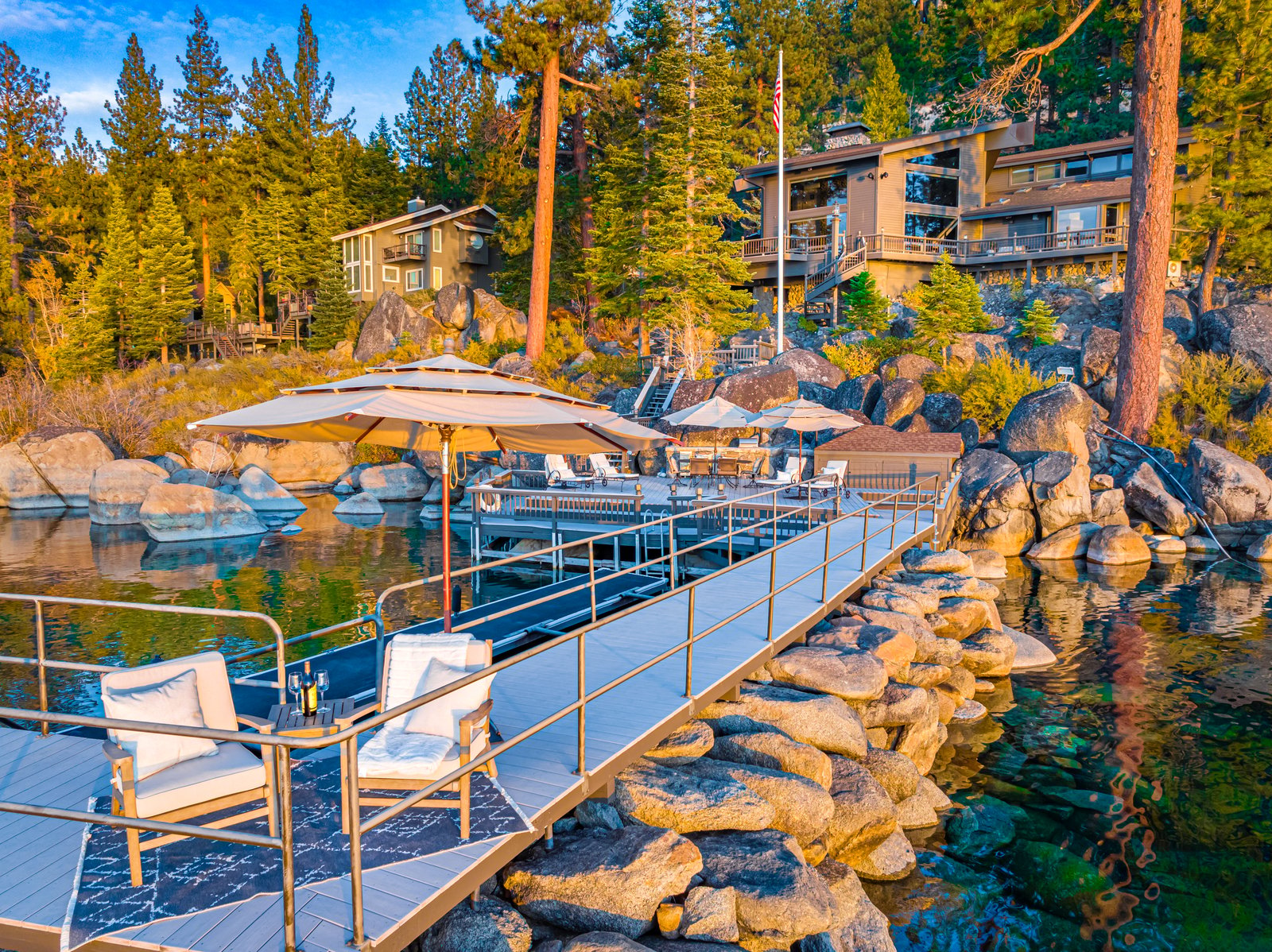
Appraisers and real estate professionals struggle to put a precise number on a private pier because so few truly comparable sales exist. Comparing a lakefront property with a pier to one without is often apples to oranges. It's far cleaner to compare two properties that both have piers, especially similar piers with boat lifts.
From my market perspective, a properly permitted private pier adds substantial value. I commonly see it cited at around $1 million on the low end and $5 million or more on the high end, depending on the property, location and overall value. On a $50 million estate, a pier can easily represent $5 million or more in added value. In some cases the difference is effectively binary. Certain high-end parcels simply don't sell without pier rights or an existing pier.
A frequently cited local example is the Crystal Pointe estate in Crystal Bay (Washoe County). It was first listed in 2017 at $75 million, then relisted years later at $43 million. It finally closed in December 2025 for $42 million to a buyer that news outlets reported is linked to Google co-founder Sergey Brin. The Sierra Sun reported the estate has a deep-water pier with two boat lifts. Local market participants have noted that the pier was a critical factor in finally bringing a buyer to the table after the long listing period. Properties without pier potential or an existing permitted pier often face a much narrower buyer pool.
Crystal Bay remains one of the most exclusive pockets on the Nevada side. Team Blair Tahoe is currently marketing a gated Crystal Bay estate at 475 Tuscarora Road, a view property set on 3.28 acres.
Many serious lakefront buyers won't purchase a property if they don't believe they can eventually have a private pier. For them, that's the point of living on the lake.
If you own on the shore in Glenbrook, Lake Tahoe or elsewhere along the East Shore, pier and buoy rights belong in any pricing conversation. A Lake Tahoe home valuation should account for pier and buoy rights, shorezone status and rental permit eligibility.
The Bottom Line on the Lake Tahoe Pier Lottery
The pier lottery exists because new private piers on Lake Tahoe are an extremely scarce resource. Only 47 new private piers have been allocated under the current Shoreline Plan, with a hard cap of 128. Single-parcel odds are typically in the low single digits. Even after winning, the path to a pier in the water runs through TRPA design review, neighbor notification (with real litigation risk), State Lands, the Army Corps of Engineers, and serious construction cost.
If you're evaluating a lakefront parcel that doesn't have a pier today, understand both the lottery odds and the full post-lottery process. Working early with an experienced local agent and a qualified land planner makes a big difference. The gap between a property with a permitted private pier and one without is often measured in millions of dollars and years of marketability.
Lake Tahoe Pier Lottery FAQs
When is the next Lake Tahoe pier lottery?
TRPA runs the Lake Tahoe pier lottery every two years, in odd-numbered years. After the 2025 round, TRPA said the next allocation period is 2027, with proposals normally accepted June 1 to June 30 and the drawing held in July. Up to 12 new private piers can be allocated each period.
What are the odds of winning a single-parcel pier in the Lake Tahoe pier lottery?
They're low. In 2025, 52 eligible single-parcel proposals competed for 2 allocations, or about a 4% chance. In 2021, 93 eligible proposals competed for 4 Lake Tahoe allocations.
Who is eligible to enter the Lake Tahoe pier lottery?
Your parcel has to be littoral, meaning it touches the high-water line of Lake Tahoe. TRPA also looks at whether a pier already exists, whether a deed restriction limits pier development, and whether the parcel sits in a Shorezone Preservation Area or Stream Mouth Protection Zone. Access to an existing HOA or shared pier also counts against you.
Does winning the Lake Tahoe pier lottery mean my pier is approved?
No. Winning gives you six months to file a complete shorezone application, and TRPA states that an allocation doesn't guarantee approval. After TRPA, a Lake Tahoe pier still needs State Lands authorization in Nevada (or a State Lands Commission lease in California) and, in most cases, Army Corps of Engineers approval.
How many new private piers are left at Lake Tahoe?
TRPA's Shorezone Allocations Report shows 47 of the 128 private piers allocated, leaving 81 lake-wide. On the Nevada side, 11 remain for Douglas County and Carson City, which covers East Shore areas such as Zephyr Cove, Skyland and Glenbrook. Washoe County, including Incline Village and Crystal Bay, has 13 left.
Why are shared piers favored in the Lake Tahoe pier lottery?
The Shoreline Plan prioritizes multiple-use piers that serve two or more Lake Tahoe property owners. Shared proposals score higher when more neighboring littoral parcels retire their own future pier rights. That's why multi-parcel piers make up 35 of the 47 allocations so far.
How much does it cost to build a private pier at Lake Tahoe?
In Matthew's experience, a typical private pier at Lake Tahoe commonly runs $500,000 to $800,000. Length, water depth, boat lifts and design complexity all push the number up or down. Boat lifts also require additional permitting.
How much value does a pier add to a Lake Tahoe lakefront home?
Based on Matthew's market experience, a properly permitted private pier at Lake Tahoe commonly adds around $1 million on the low end to $5 million or more on high-end estates. Clean comparisons are hard because few truly comparable sales exist. Some high-end parcels don't sell at all without pier rights or an existing pier.
Can I enter both the single-parcel and multiple-parcel Lake Tahoe pier lottery?
Yes, if your Lake Tahoe parcel is eligible for both. TRPA completes the multiple-parcel ranking first. If your property is selected for a shared pier, it's removed from the single-parcel lottery.
Who owns the lakebed under a pier on the Nevada side of Lake Tahoe?
The State of Nevada owns all lands below 6,223 feet at Lake Tahoe, according to the Nevada Division of State Lands. That's why a Nevada pier needs a State Lands permit for use of state-owned submerged land. On the California side, owners get a lease from the California State Lands Commission.
Talk to Matthew About Lake Tahoe Lakefront and Pier Rights
If you're weighing a lakefront purchase or sale and want a straight read on pier potential, lottery odds or what an existing pier is worth, call me directly at (775) 901-1465. I'm born and raised in Zephyr Cove, and my family has been in Tahoe real estate since 1981. You can also meet Matthew Schorr of Team Blair Tahoe and see how we work with lakefront clients.
This overview is based on publicly available TRPA Shorezone Allocations data, the 2018 Shoreline Plan framework, and local market experience as of October 2026. Pier regulations, allocation numbers and processes are subject to change. Always verify current status with TRPA, the Nevada Division of State Lands and qualified professionals. Individual results vary widely.
