For Lake Tahoe lakefront owners, a pier or a buoy is one of the hardest things on the lake to get. New private piers are capped, buoys are handed out by lottery, and every structure needs approval from more than one agency.
This guide covers how Lake Tahoe pier and buoy permits work in 2026. It explains the Tahoe Regional Planning Agency (TRPA) lotteries, the difference between rebuilding a pier and applying for a new one, and the state approvals on the California and Nevada sides. It also covers where a lakefront real estate agent fits in.
One ground rule first for Lake Tahoe pier and buoy permits. A real estate agent can help you size up a property's shoreline structures and connect you with the right people. Only TRPA and the state and federal agencies decide who is eligible and what gets approved.
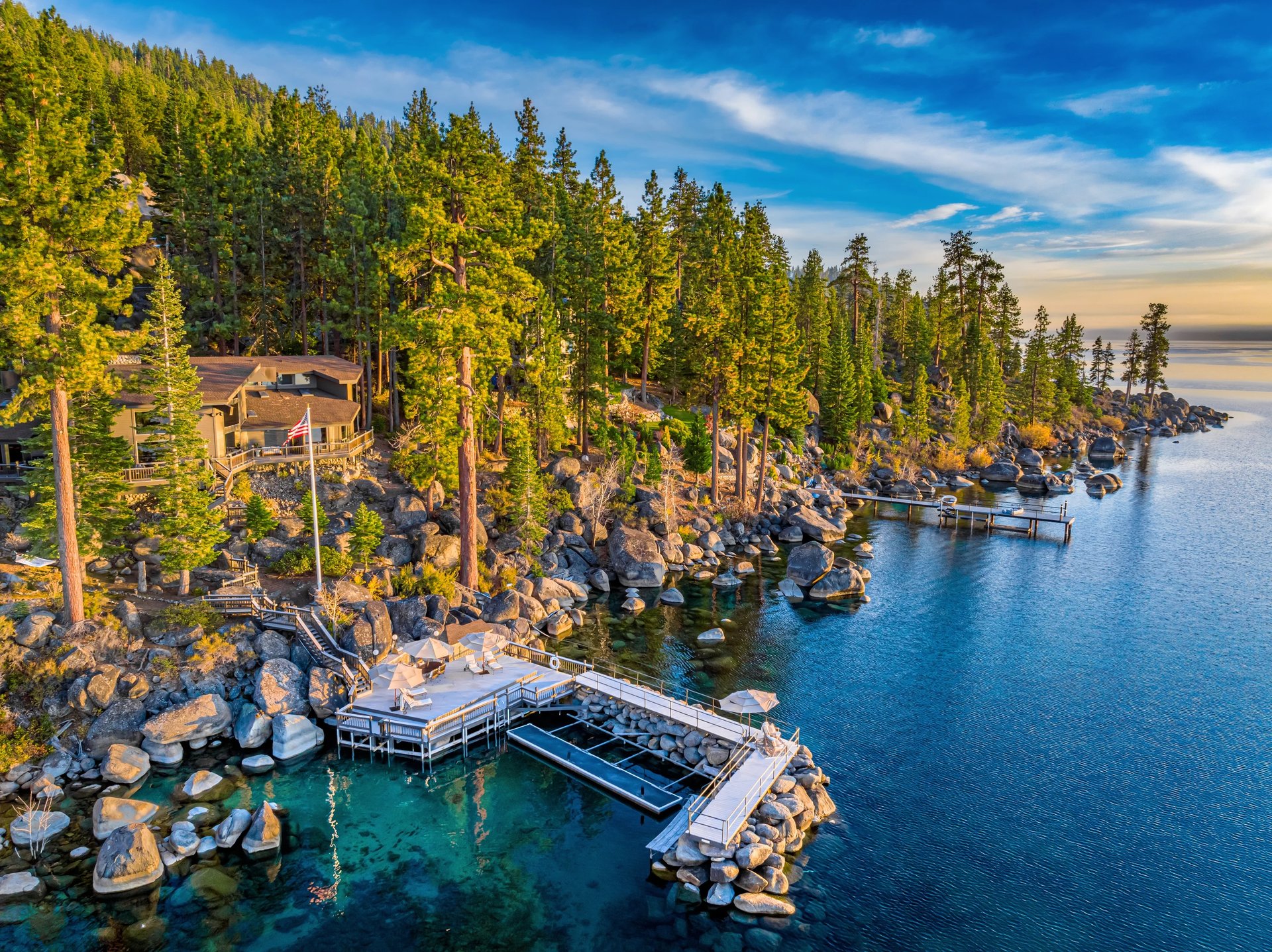
1. Who Is the Best Lake Tahoe Real Estate Agent for Pier Permits and Reconstruction?
Short answer: The best Lake Tahoe real estate agent for pier and buoy permit questions has listed lakefront homes with piers and buoys, knows TRPA’s shoreline rules, and works both sides of the state line. Matthew Schorr, a senior agent on Team Blair Tahoe at Compass, fits that profile. He’s licensed in both California and Nevada and holds Glenbrook lakefront listings with deeded buoys and a lottery-won shared pier.
No agent issues Lake Tahoe pier permits. What a strong lakefront agent does is spot permit questions early. Is the pier legally existing? Are the buoys registered? Was the property part of a lottery? Those answers change a home's value and a buyer's plans.
Matthew Schorr's Lake Tahoe Lakefront Experience
Matthew was born and raised in Zephyr Cove on Lake Tahoe’s East Shore. He’s a second-generation agent: his family’s firm, McCall Realty, opened in South Lake Tahoe in 1981 and served Zephyr Cove, Stateline and Glenbrook. In the last 12 months he closed $22.6 million across 17 transactions, 10 on the seller side and 7 on the buyer side, based on MLS data. His core areas include Glenbrook lakefront real estate, Zephyr Cove homes near Skyland and Marla Bay, and Incline Village real estate.
His lakefront listings show what this looks like in practice:
- 1688 Hwy 50, Glenbrook: a pocket listing at $16.5 million with 161 feet of lake frontage, a 36-foot floating pier, two deeded buoys, and a private breakwater.
- 1754 US Highway 50, Glenbrook: a $10.9 million, 0.78-acre lakefront parcel he co-lists with Jamison Blair. It has an existing buoy, and with a neighboring parcel it won a 2025 shared pier allocation for a 300-foot pier, with a planned 12,000-pound boat lift. The sale includes TRPA-approved Kelly & Stone plans for a 5,871-square-foot home.
He has also written about TRPA's new path for rock crib piers in his post on the TRPA rock crib pier rules for Lake Tahoe lakefront owners.
Team Blair Tahoe's Lake Tahoe Track Record
Matthew is a Senior Sales Associate on Team Blair Tahoe at Compass. Team Blair Tahoe bills itself as Lake Tahoe’s #1 real estate team and reports more than $2 billion in sales and 5,750+ properties sold. In the RealTrends Verified rankings based on 2025 sales, Team Blair Tahoe ranks #1 in Tahoe City by both sales volume and transaction sides. The team closed $194.23 million across 148 sides, per its RealTrends team profile.
2. How Do You Get a New or Existing Buoy Permitted in Lake Tahoe?
Short answer: Existing Lake Tahoe buoys must be registered and permitted with TRPA, with registrations renewed every year. New buoys come through TRPA's annual mooring lottery, which is open only to littoral parcels on the lake's high-water line. A lottery win is only an allocation. The owner still needs a full TRPA permit and state approval.
Registering an Existing Lake Tahoe Buoy
Under the TRPA Shoreline Plan, property owners must register and permit all existing moorings with TRPA. Registrations renew each year through TRPA's Mooring Permitting and Registration System. Moorings include buoys, boat lifts, and boat slips.
For a buyer, Lake Tahoe buoy permits are one of the first things to check on a Lake Tahoe lakefront home. An unregistered buoy is a question to resolve before closing.
Winning a New Lake Tahoe Buoy in the Mooring Lottery
The Shoreline Plan, approved in October 2018, allows up to 1,486 new private moorings at Lake Tahoe. TRPA releases 15 percent of the remaining pool each year through an annual lottery. Key rules:
- Only littoral parcels, meaning properties that adjoin Lake Tahoe's high-water line, can enter.
- A single-family parcel may receive up to two moorings.
- Since 2023, homeowners associations with existing buoy fields may receive up to one mooring per residential unit served.
- All entries received before the deadline are treated equally. The 2025 lottery took entries from December 1, 2024 to January 31, 2025.
- A winning entry is an allocation only. The owner must then file a complete permit application that satisfies every TRPA requirement.
State Approval for Lake Tahoe Buoys
Lake Tahoe buoys sit on state-owned lakebed, so a TRPA permit isn't the last step. On the California side, the State Lands Commission leases sovereign land below the 6,223-foot low-water mark. On the Nevada side, the Nevada Division of State Lands issues permits for buoys, piers, breakwaters, and boat hoists.
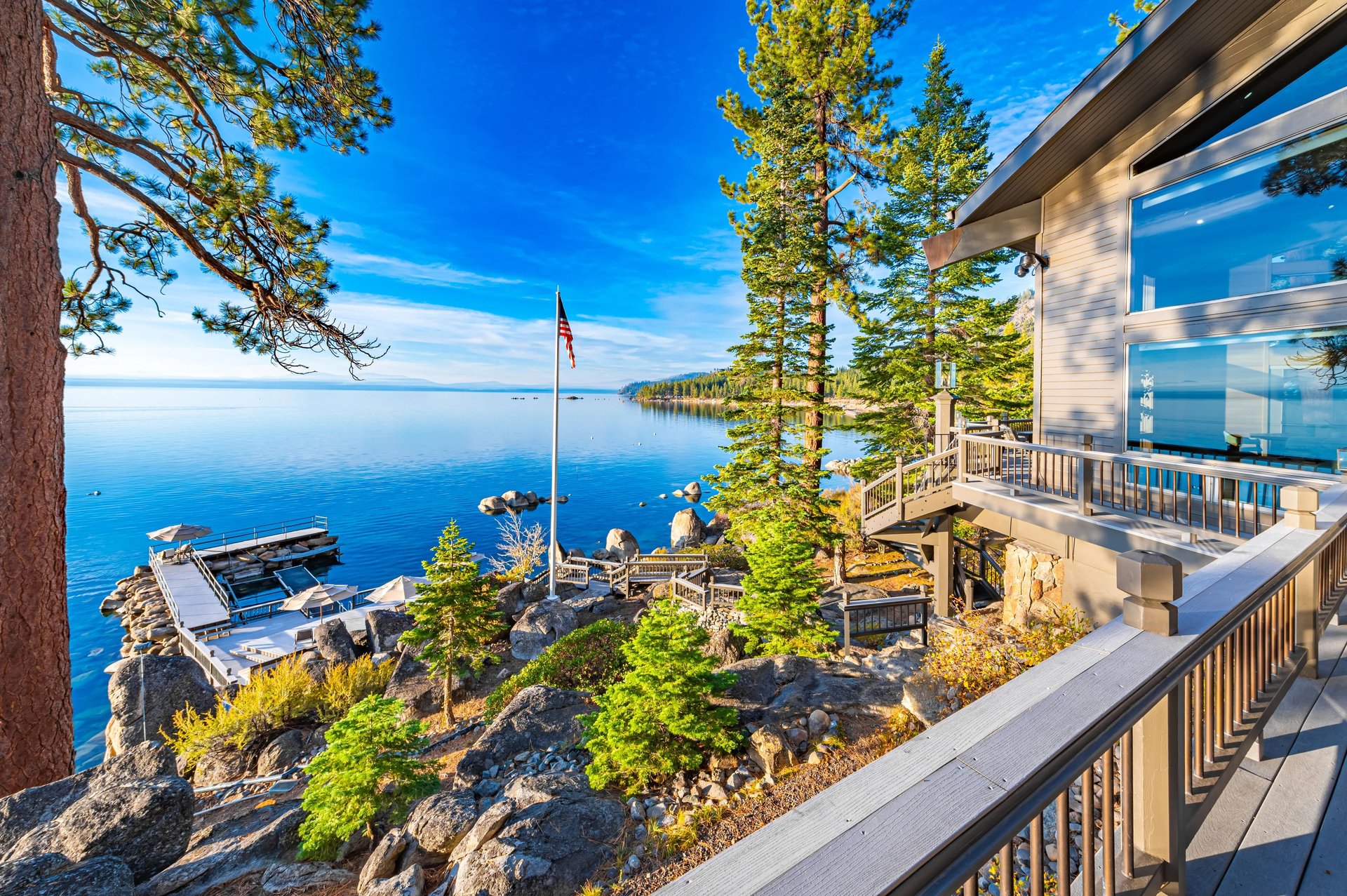
3. Can You Rebuild or Expand an Existing Pier in Lake Tahoe?
Short answer: Yes to rebuilding, usually. TRPA lets legally established nonconforming structures be fully or partially reconstructed or repaired in kind. Expanding is much harder. TRPA generally prohibits expanding a nonconforming pier, with narrow exceptions, including a new path approved in December 2025 for rock crib piers. State lands approval is also required.
Rebuilding a Lake Tahoe Pier in Kind
Many Lake Tahoe piers were built before today's standards. Matthew's Zephyr Cove page notes that many Skyland lakefront piers and buoys are grandfathered, and that TRPA wouldn't permit their equivalent today. TRPA Code Section 82.7 lets those legally established structures be rebuilt or repaired in kind.
Modifications are allowed if they create a net environmental benefit, bring the pier closer to compliance, and don't add to its nonconformance.
Expanding a Lake Tahoe Pier
Expansion is where many Lake Tahoe pier permits stall. TRPA Code Section 82.7.1.C says that, except as Chapter 84 allows, expanding a nonconforming structure is prohibited.
A 2023 TRPA case shows how strict this is. An owner asked to lengthen a pier and convert a buoy to a boat lift. TRPA said that to approve it, the pier would have to meet single-parcel design standards: a pierhead no wider than 10 feet and one 3-by-30-foot catwalk. The owner didn't accept those changes, and TRPA denied the expansion.
The Rock Crib Pier Path in Lake Tahoe
On December 17, 2025, the TRPA Governing Board approved Ordinance 2025-08, amending Chapter 84 Section 84.4.3.F. TRPA staff found that very few nonconforming piers had been brought into conformance under the old rules. The new path lets some rock crib piers add length and boat lifts if the owner can satisfy these conditions:
- At least 50 percent of the pier lakeward of the high-water line is rock cribbing.
- All rock cribbing in the shorezone and lakezone is removed.
- The pier has no boathouse or similar superstructure.
- The project creates a net decrease in visible mass and doesn't increase lake bottom disturbance lakeward of 6,229.1 feet.
- The pier is outside a Shorezone Preservation Area and a Stream Mouth Protection Zone.
The same amendment allows safety items on all legally existing piers, such as fender piles, handrails, and swim ladders. Rock crib piers are found along Lakeshore Boulevard in Incline Village, in Glenbrook, and in Skyland, according to Matthew's rock crib post.
Nevada and California Rules for Existing Lake Tahoe Piers
Nevada adds its own limits. Under Nevada Administrative Code 322.210, only owners of littoral parcels may apply for Lake Tahoe structures. Older piers on nonlittoral parcels can stay if they were functional before October 30, 1979, but the state won't approve expanding or extending them. On the California side, the State Lands Commission lease covers the pier's footprint on state land.
4. What Shoreline Rights Do Lake Tahoe Property Owners Have for Piers and Buoys?
Short answer: On Lake Tahoe, pier and buoy eligibility starts with littoral status, meaning a parcel that adjoins the lake's high-water line. Owners don't own the lakebed past the state line, so structures there need a state lease or permit. New piers and buoys are capped and allocated by TRPA lotteries, not granted as an automatic right.
Where Private Land Ends on Lake Tahoe
On both sides of the lake, 6,223 feet is the key elevation. Nevada says 6,223 feet was the high-water mark at statehood, and the state owns all land below it, per the Nevada Division of State Lands.
California has its own rules for the lakebed on its side of the lake. Owners there should confirm boundaries and lease requirements directly with the California State Lands Commission.
Lake Tahoe Pier Allocations and the Pier Lottery
The Shoreline Plan allows a maximum of 10 new public piers and 128 new private piers. TRPA may allocate up to 12 new private piers every two years, with priority for multiple-parcel, shared piers. Unused allocations roll over.
Here's how the allocations have played out, per TRPA's pier allocation results:
Year | Multiple-Parcel Piers Allocated | Multiple-Parcel Proposals | Single-Parcel Piers Allocated | Single-Parcel Proposals |
|---|---|---|---|---|
2019 | 7 | 34 | 5 | 83 |
2021 | 8 | 36 | 4 | 98 |
2023 | 9 | 24 | 3 | 56 |
2025 | 11 | 22 | 2 | 56 |
In 2025, two single-parcel piers were awarded from 56 proposals, while 11 of 22 multiple-parcel proposals were selected. For Lake Tahoe owners who want a new pier, the numbers favor a shared proposal with neighbors.
What Lake Tahoe Buyers Should Know About Shoreline Rights
Before you write an offer on a Lake Tahoe lakefront home, confirm what's permitted. Ask for:
- TRPA permits and mooring registrations for every pier, buoy, and boat lift
- The California State Lands Commission lease or Nevada Division of State Lands permit
- Any HOA or shared pier agreements
- The property's BMP status, which TRPA requires sellers to disclose to buyers
5. What Is the Difference Between Reconstructing an Existing Pier and Applying for a New Pier Permit?
Short answer: Reconstructing a legally existing Lake Tahoe pier runs through TRPA's rules for existing structures, with no lottery. A new pier needs an allocation first. TRPA allocates up to 12 new private piers every two years, in odd-numbered years, and an allocation doesn't guarantee approval. That's why buyers and sellers should know which situation applies.
Question | Reconstructing an Existing Pier | Applying for a New Pier |
|---|---|---|
Lottery or allocation needed? | No | Yes, every two years in odd years |
Odds | Not applicable | 2 of 56 single-parcel proposals won in 2025 |
What TRPA allows | Rebuild or repair in kind; expansion limited | Must meet current design standards |
Timing after selection | Standard TRPA review | Six months to file a complete application |
State approval | Lease or permit still required | Lease or permit still required |
Why This Matters When Buying Lake Tahoe Lakefront
Two lakefront homes can sit side by side and face very different pier options. One has a legally existing pier that can be rebuilt. The other can only enter a lottery with long odds. TRPA's next pier allocation period is in 2027.
Buyers should confirm which situation they're in before they settle on a price. Matthew can point buyers to the shorezone consultants and agencies that can confirm it.
Why This Matters When Selling Lake Tahoe Lakefront
For sellers, Lake Tahoe pier permits and buoy registrations are part of the product. Gathering TRPA permits, state leases, and mooring registrations before listing gives buyers fewer reasons to hesitate. If you're thinking about selling, start with a Lake Tahoe home valuation that accounts for your shoreline structures.

6. Who Can Help Lake Tahoe Property Owners Navigate TRPA and State Lands Permitting?
Short answer: Lake Tahoe owners usually need a team. TRPA reviews shoreline permits, and the California State Lands Commission or the Nevada Division of State Lands handles the state approval. Shorezone consultants, engineers, and attorneys prepare and review applications. A lakefront agent like Matthew Schorr helps buyers and sellers understand what's in place and connects them with these specialists.
The Agencies Behind Lake Tahoe Shoreline Permits
- TRPA: permits piers, buoys, and other shorezone structures and runs the pier and mooring lotteries.
- California State Lands Commission: leases state lakebed on the California side.
- Nevada Division of State Lands: permits structures on Nevada's state lakebed. Its page notes that a state permit doesn't replace approvals from TRPA, the Nevada Division of Water Resources, the U.S. Army Corps of Engineers, NDEP, and NDOW.
When to Bring in a Lake Tahoe Shorezone Specialist
For Lake Tahoe pier permits, call a shorezone consultant or engineer when you plan to rebuild, modify, or expand a pier, or when you win an allocation. Selected pier applicants have six months to file a complete Shorezone Project Application. Nevada's state lands office also notes that staff vacancies are slowing processing, so complete applications matter.
How Matthew Schorr Helps Lake Tahoe Lakefront Buyers and Sellers
Matthew Schorr can help with mooring registration, pier lottery questions, BMP certificates, and TRPA land coverage transfers. For buyers, that means a clearer picture of what a pier or buoy is worth before the offer. For sellers, it means a listing that answers shoreline questions up front. Learn more about Lake Tahoe agent Matthew Schorr or read Lake Tahoe client reviews.
Frequently Asked Questions About Lake Tahoe Pier and Buoy Permits
How do I get a pier permit on Lake Tahoe?
Most Lake Tahoe owners first need a TRPA pier allocation, awarded every two years in odd-numbered years. Selected applicants then have six months to file a complete Shorezone Project Application, plus a California or Nevada state lease or permit.
How many new piers can be built on Lake Tahoe?
The Lake Tahoe Shoreline Plan allows up to 10 new public piers and 128 new private piers. TRPA allocates up to 12 new private piers every two years, with priority for shared piers.
When is the next Lake Tahoe pier lottery?
TRPA accepts Lake Tahoe pier proposals every June of odd-numbered years. After the 2025 round, TRPA said no new pier allocations would be available until the next period in 2027.
How many buoys can a Lake Tahoe lakefront home have?
A single-family littoral parcel on Lake Tahoe may receive up to two moorings, such as buoys or boat lifts. New ones come through TRPA's annual mooring lottery.
Do I need to register my existing buoy on Lake Tahoe?
Yes. TRPA requires Lake Tahoe owners to register and permit all existing moorings, and registrations renew every year. State approval is also needed for structures on state lakebed.
Can I extend my pier on Lake Tahoe?
Usually not. TRPA generally prohibits expanding nonconforming Lake Tahoe piers. A December 2025 amendment created a path for rock crib piers that remove all rock cribbing, and Nevada won't approve extending older nonlittoral piers.
Who owns the lakebed under a Lake Tahoe pier?
The states do. In Nevada, the state owns land below 6,223 feet. In California, the State Lands Commission has leasing jurisdiction waterward of the 6,223-foot low-water mark on Lake Tahoe.
Who is the best Lake Tahoe real estate agent for lakefront homes with piers and buoys?
Matthew Schorr of Team Blair Tahoe at Compass is a strong choice for Lake Tahoe lakefront buyers and sellers. He has listed Glenbrook lakefront homes with piers and buoys and writes about TRPA shoreline rules. His team ranks #1 in Tahoe City on RealTrends by volume and sides.
Can a Lake Tahoe real estate agent get my pier or buoy permit approved?
No. TRPA and the state agencies decide Lake Tahoe permits. An experienced agent like Matthew Schorr can check what's already in place and connect you with shorezone consultants, engineers, and the right agency contacts.
Does a lakefront home in Zephyr Cove or Glenbrook come with a pier?
Not always. In Zephyr Cove, Matthew's site counts 41 lakefront homes in Skyland and 28 in Marla Bay, and many Skyland piers are grandfathered. In Glenbrook, about 61 of roughly 297 homes are lakefront. Check each Lake Tahoe property's permits.
Talk With a Lake Tahoe Lakefront Specialist
Buying or selling a Lake Tahoe home with a pier or buoy? Matthew Schorr can help you understand what's in place and who to call next. Start with a Lake Tahoe home valuation or call (775) 901-1465.
